



The churches
Church of the Cross - Capri
The Church of the Cross, situated in the high part of Capri, at the end of Via Salita Croce, is generally only open for religious services.
Whilst it has been ascertained that the building was constructed at some time between the twelfth and fifteenth century, the architect and person responsible for the Church’s enlargement are still subject of debate.
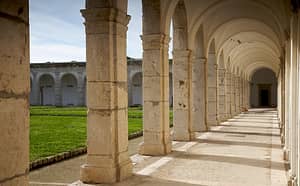
The complex is surrounded by a high boundary wall. The entrance is formed by a covered portico, and surmounted by a small bell tower. The entrance portal features a late gothic lunette in grey stone. The building was once a small convent with three entrances, of which only the principle one remains. The garden in front of the churchyard was used as a cemetery until 1600.
Church of St Maria del Soccorso - Capri
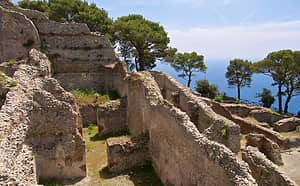
Within the archaeological site of Villa Jovis one finds the tiny Church of St Maria del Soccorso. The building is dated 1610, although it is believed that the structure already existed in 1570, when Fabio Giordano mentioned a certain Church of St Leonardo in exactly the same location. The Church of St Maria del Soccorso reflects the typical architecture of Capri with vaulted ceilings and extremely simple interiors. There is a canvas of the Madonna, and an altar, the latter donated by a group of islanders who emigrated to Argentina. The small sacristy was originally a hermitage. In the area next to the church a statue of the Madonna has been erected, which can be seen from the sea.
German Evangelical Church - Capri
The German Evangelical Church of Capri is situated at the start of Via Tragara. It was built in the early 1900’s, commissioned by a group of German industrialists who chose to take up residency in Capri.
The style of the Evangelical Church is typically transalpine, unusual for Capri, with sloping roofs and brick roofing tiles. The church boasts a large majolica plaque with the wording “Deutsche Evangelische Kirsche”.
Church of St Anna (St Maria delle Grazie) - Capri
The Church of St Anna, now deconsecrated, was the parish church of Capri until 1595. Recently restored, the building can be found in the heart of the Medieval part of Capri, after the first archway of Via Le Botteghe in an alleyway on the left hand side. The Church was dedicated to St Anna, protector of women in childbirth, in that it was here that infants were traditionally baptised. The building dates back to the thirteenth century. Two steps higher than the level of the road, the church has a small churchyard featuring a pair of columns on which, originally, there would have been a pergola. The interior is characterized by three barrel vaulted naves, and two small lateral naves with round arches. The church contains a number of roman elements removed from the imperial villas on the island. In the right hand apse there is a fourteenth century fresco depicting the Madonna and Child between Fra San Pietro and San Jacopo.
Ex Cathedral of St Stefano - Capri
At the top of the flight of steps in the Piazzetta di Capri one finds the ex Cathedral of St Stefano, built between 1688 and 1695, on the site of a Benedictine convent. The exterior is characterized by domes and extradoss vaults. The interior has marble paving, retrieved from the Roman villas on the island of Capri, including that if Villa Jovis.
The third chapel on the left, the Sacro Cuore, houses relics of various saints. Along the corridor of the sacristy one can observe the statue of St Costanzo, patron saint of Capri.
Church of Santissimo Salvatore - Capri
The Church of Santissimo Salvatore was built between 1661and 1685 at the same time as the annexed Convent delle Teresiane.
It can be found close to the Piazzetta of Capri, by following the medieval lanes beyond the steps of the Church of St Stefano.
The façade has a central arch and two lateral niches, the flight of steps leading to the entrance is built on two converging ramps.
The interior if covered by a barrel vaulted ceiling, there are two chapels either side and a women’s gallery from where the nuns, protected by a thick grated screen, used to attend the religious services.
Church of St Costanzo or of Maria della Libera - Capri
The Church of St Costanzo is the oldest in the whole of Capri and is situated in the vicinity of Marina Grande in the first section of the Strada Provinciale. The church, constructed on the site of a late republican era Roman Palazzo sometime around the sixth century A.D, was built to the typically Byzantine plan of the Greek Cross and covered by domed vaults. During the centuries, the church has been modified and enlarged on various occasions. For example the Arab style bell tower was a much later addition to the building.
The interior columns originated from the maritime villa of the Emperor Tiberius in Palazzo a Mare. In 1990 the church underwent a major restoration project which brought to light a number of interesting features such as the roman paving in pous signinum and a section of brick wall dating back to the sixth century. Dedicated to St Costanzo, the patron saint of the island of Capri, the church also observes the cult of the Madonna della Libera.
Church of Sant'Andrea - Capri
The small Church of Sant’Andrea is situated in Marina Piccola, built on the site of an old watch tower. It was commissioned by husband and wife Hugo and Emma Andreas in 1900 thereby granting the wish of the local sailors to have their own church. Built to the designs of Riccardo Fainardi, it contains a triptych by the artist di Parma depicting the life of the Saint. It is covered by a dome, has a small bell tower and, inside, the pronaos is supported by two columns. A winding staircase leads to a space above which there is the organ.
Church of St Maria of Constantinople - Anacapri
The Church of St Maria of Constantinople dates back to approximately the year 1200 and is situated in the area where the first houses of Anacapri were built, along the road leading to the Migliera viewpoint. Formed by a cross vaulted square hall, the church has rural origins, with a rudimentary façade and bell tower. It has a small avenue of cypress trees and a garden once used as a cemetery. It was the parish church of Anacapri until 1510.
Church of St Michele Arcangelo - Anacapri
The Church of St Michele Arcangelo is situated in Piazza San Nicola in Anacapri. It was built between the seventeenth and eighteenth century at the same time as the rest of the Teresian complex of which it was an integral part. It was built on an octagonal plan in the form of a Greek cross. The church of St Michele Arcangelo has a beautiful pavement decorated with painted majolica tiles A design attributed to Solimene and executed by the master Chiaieses, this stunning floor painting depicts Adam and Eve in the earthly paradise, immersed in a surreal landscape, featuring imaginary and mythological animal forms such as the Unicorn. The lateral altars containing paintings by Nicola Malinconico, De Matteis and del Po are also considered to be of great artistic importance.
Church of Sant'Antonio - Anacapri
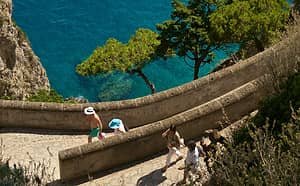
The Church of St Antonio, also known as the sailor’s church, is situated half way up the Phoenician Steps. Built in the sixteen hundreds, it has been restored on various occasions and in the nineteenth century a sacristy and bell tower were added. The interiors of the church are comprised of a small entrance and square hall with a convex vault, for the religious ceremonies. It is said that the building was initially used as a refuge for sailors returning from the sea, who adorned it with a painting of the saint, and from that moment on the building assumed a sacred nature. The church has a small sacristy, with seat, where those climbing up the long flight of steps could rest, in the days the steps represented the only pathway leading to Anacapri. The sacristy’s form also results from its being used as a check point, monitoring movement along the Phoenician steps. During the first thirteen days of June, pilgrimages are made to the church in observance of the cult of St Antonio di Padova, the Patron Saint of Anacapri.
Church of Santa Sofia - Anacapri
The Church of Santa Sofia was erected in 1510, substituting the previous parish church of St Maria of Constantinople. It lies in what is now the center of Anacapri, where the population started to gather following its construction. The sacristy and the oratory were obtained from the previous Church of St Carlo, the interior is covered with a barrel vaulted ceiling and has two side chapels which were added to the building at the end of the seventeenth century. The two bell towers and presbytery were completed in 1878.
Church of Santa Maria a Cetrella - Anacapri
The hermitage of Santa Maria a Cetrella was built in the XV century right on the edge of a sheer cliff face towering above Marina Piccola. Comprised of a tiny church, a bell tower, and a sacristy, with a low dome which was added in the seventeenth century. Inside, there is also a chapel. The back of the church leads out on to a terrace, part of which is sheltered by a wisteria covered pergola and furnished with benches and a long rustic wooden table. Hermits belonging to the Franciscan and Dominican orders in spiritual retreat used to reside here, as testified by the cells, a large and well equipped kitchen, wash areas and a kitchen garden.
Non Catholic Cemetery
The Non Catholic cemetery was built in 1878, next to the Catholic Cemetery, along the Strada Provinciale leading to Marina Grande. Symbol of the island’s cultural tollerance, it was the result of the growing necessity to find a place where the non Catholics who had chosen to live in Capri could be buried after their death. Among the foreign residents buried here are the Scottish author Norman Douglas; Count Fersen; Grace Fields, the English singer who was the first owner of the bathing establishment “Il Canzone del Mare”; and the French publisher Camille Du Locle.